

In this post, I explain the broken incentives behind infrastructure development in the US (the "merchant transmission paradox"), and I propose a solution that I term "development alpha." This essay was originally posted to Power 2026.
In the late 2000s, Quebec had cheap and abundant hydro power. Yet the power price in Manhattan (Zone J) remained exorbitant.
To solve this, Transmission Developers Inc. (TDI) proposed the Champlain-Hudson Power Express (CHPE) transmission line from Quebec to Zone J in 2010. Such a transmission line would allow the cheap power to meet demand where it was most needed. Yet due to misaligned incentives, the transmission line couldn’t be financed until 2021.
There are only two ways that transmission lines get paid for in America. The first way is when the grid planners conduct a reliability analysis and decide that to prevent the possibility of blackouts, the grid needs a new power line. In that case, the transmission line operator receives some fixed return paid by those who consume electricity (”ratepayers”). This is 95% of power lines in the US.
The other way is permissionless. Anyone can build a transmission line and get compensated via “congestion”: the price difference between two regions that occurs when a line is at capacity. In the case of CHPE, congestion is the price difference between Quebec and Zone J. But an “ideal” transmission line will move cheap power to the more expensive region until the prices are roughly equal. In other words, the transmission line destroys the very congestion from which it benefits. This is known as the merchant transmission paradox.
Over the next decade, TDI got the permits it needed, but no one was willing to privately finance the construction of CHPE. In 2021, New York state finally offered a 25-year revenue contract, providing long-term cash flow for the power the line delivered.
It took state intervention to finance infrastructure that massively benefited local residents. What we need is a way for private market participants to finance that sort of build on their own.
Case Study: The Story of Indonesian Nickel
There’s precedent for private market participants to generate revenue for what they build via derivatives. A famous recent example is billionaire “Big Shot” Xiang Guangda of Tsingshan Holding Group, who announced new nickel production lines in 2021 and attempted to amplify his returns by trading. This is the story of how that went horribly wrong.
To understand Xiang’s trade, you need some background on nickel. Nickel can have various levels of purity: nickel ore (~2% purity), nickel pig iron (~10%), nickel matte (50-75%), and refined nickel (99%+). Class 1 nickel requires 99.8% purity, and it’s tradeable on the London Metal Exchange (LME), whereas lesser purities are called Class 2 nickel. Nickel is an input into stainless steel, batteries, and a handful of alloys.
In early 2021, Xiang announced new Indonesian nickel production lines to convert nickel pig iron into nickel matte. Until then, the only realistic option for batteries was refined nickel, because there wasn’t enough nickel matte supply. Since battery manufacturers were expected to buy nickel matte instead of refined nickel once Xiang’s production lines went live, LME Class 1 nickel dropped by 9% that same day.
But through 2021, the demand for electric vehicles was so strong that the refined nickel price rose anyway. EV batteries physically consumed larger and larger proportions of the Class 1 nickel supply. Xiang’s view was that the price rally didn’t adequately account for his upcoming nickel operations, so he opened a large short position on Class 1 nickel.
In a commodities market, some participants are speculating, and they intend to eventually close their trade. Buyers need to sell their position, and sellers need to buy back their position. Xiang was a speculator who sold. Other market participants buy or sell because they are physically consuming or producing the commodity.
Multiple dynamics were at play. EV battery manufacturers needed to take delivery, so when they bought Class 1 nickel, they had no intention of selling. The remaining sellers were speculators. Eventually, Xiang needed to buy to close his trade, and he’d be at the mercy of the speculators.
Not long after, Russia invaded Ukraine in early 2022. Russia is one of the largest producers of refined nickel, and markets were concerned about a potential sanction. Class 1 nickel prices skyrocketed.
All the reasonable sellers had already sold their Class 1 nickel to the battery manufacturers. Xiang’s short position was large enough that the remaining participants were only willing to sell at unreasonably high prices. On top of that, his production was for nickel matte, which is not Class 1 nickel, so he couldn’t physically meet his obligations either.
The remaining sellers understood Xiang’s dilemma, and they held. This trade would have bankrupted Xiang’s company. Luckily for him, the LME halted the nickel market and cancelled all of the trades that day, which became the subject of a (later dismissed) lawsuit from Jane Street and Elliott. Typically when a trade is losing this much money, brokers will force a trader to exit their position and take the loss. Instead, banks agreed to hold off on liquidating Xiang’s position, and he was able to fully close by mid-2022 as markets settled down.
The most common takeaway from this story is “I wouldn’t want to be the nickel guy.” The reality is more nuanced. In theory, Xiang could have just profited from his nickel production lines and avoided trading altogether. But note that by late 2023, Xiang’s prediction for refined nickel came true, and the nickel finally traded below his entry price.
It’s sort of a shame, right? On some time frame, Xiang was right. He had superior knowledge of the upcoming market impact from his physical operations. Where did he go wrong?
Hallmarks of Development Alpha
There’s no standard theory to characterize Xiang’s trade (probably because no one wants to replicate it). But under the right conditions, I think that the high-level concept—trading on the market impact of your own infrastructure—can be profitable with lower risk.
Here I propose the concept of “development alpha”: the incremental return achievable via derivatives, beyond the ordinary cash flow that infrastructure earns, by trading on the market impact that the infrastructure will cause. The additional return from development alpha can make a project viable when it previously wasn’t.
But development alpha might not always be safe to capture. The following criteria are worth considering:
First-order impact: The development of the project directly impacts the value of your position (not via second-order effects). Xiang’s trade required battery producers to start using nickel matte, rather than a first-order impact on Class 1 nickel.
Isolation: Idiosyncratic factors (e.g. Russian nickel production) cannot impact the trade to the degree that it can’t survive the relevant time period (construction time + settlement). Some derivatives are more susceptible to black swan events than others, and the analysis depends heavily on the specific trade being made.
Limited loss: The trade has bounded downside, meaning only so much money can be lost. This might be because you’re purchasing an instrument where the max drawdown is the premium, or your developed asset can physically settle your position. Had Xiang produced Class 1 nickel, he could have physically met his obligations.
Absorption: The position relative to the purchasable supply needs to be small enough that it is arithmetically unattractive for people to buy the remaining supply and refuse to sell. After accounting for the battery manufacturers’ purchases, Xiang needed to buy back a huge percentage of remaining supply.
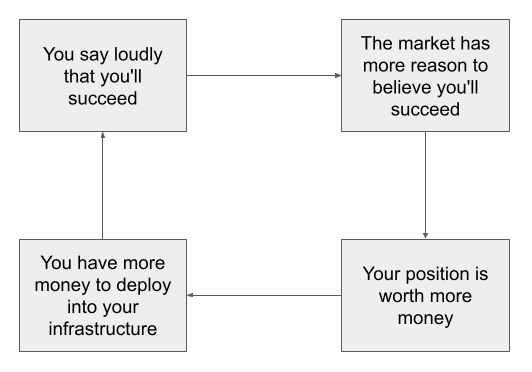
If it works, there’s reflexivity built-in: If the market anticipates you’ll succeed, your position’s value will increase. That means you have more capital to deploy into the infrastructure build, which increases your probability of success. It’s a virtuous cycle. In practice, you’d want to make sure the infrastructure build is fully financed, so even a bad trade can’t cause the whole project to go under.
Let’s look at a concrete example.
My Proposal: Batteries & Flowgates
An ideal infrastructure build directly impacts a corresponding liquid instrument. In general, markets more than 2 to 3 years out are illiquid, meaning it’s not possible to place big trades far into the future. That biases us toward shorter projects that require less capital. Below is an example of an infrastructure project that can yield development alpha: a battery strategically placed at a flowgate.
A “flowgate” refers to a line that’s monitored so it doesn’t exceed its limit. When a line reaches capacity, that’s exactly what causes price differences on the grid, so on one side of the transmission line, power is cheaper than on the other side. Recall that the “congestion” between two locations is the difference in their prices. In this example, our goal is to reduce congestion and make a trade that benefits from that reduction.
Batteries don’t cost much to build relative to an entire power plant. The key property of batteries is that they buy power at a node when the price is low (e.g. California daytime) and sell power at that same node when the price is high (e.g. evening). Batteries are welfare-maximizing because they provide power at the time when it’s most needed.
To extract development alpha, the idea is to put the battery on the cheap side of a flowgate. Call the cheap side Node A, and the expensive side Node B. When the power line hits its limit, that means there’s a bunch of cheap power stuck at Node A, so that’s the optimal time for the battery to charge. Charging the battery (buying power) when the price is cheap will increase the price at Node A, thereby reducing congestion: Node B - Node A.
Before anything is built, make a trade that will benefit from your predicted decreased congestion. This way you get in early, before the market accounts for the new infrastructure. The instrument to sell for this trade is called the “financial transmission right (FTR) obligation” along the path from A to B. The following diagram explains the payoff of this trade:
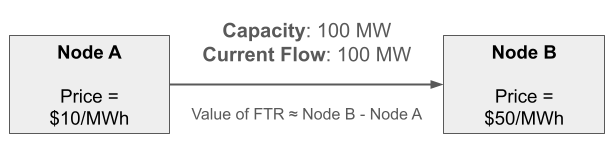
I’m going to break this down for those who are unfamiliar with FTRs. When you sell the FTR obligation, you receive [(Node B) - (Node A)], at whatever the prices are when you open the trade. When you settle, you have to pay back [(Node B) - (Node A)] at whatever the realized prices are. Therefore, your profit is the difference between those two spreads. In an ideal world, the price difference is wide when you open the trade, and the prices are close when you settle.
Let’s say you think the battery will take one year to construct, and you open an FTR position for next year. (The position should settle after construction.) Historical data will indicate that the line between Node A and Node B frequently hits its limit, so the FTR will reflect a big price difference between those nodes before the battery is built. You’ll publicly announce that you’re building a battery, but traders tend to discount announcements like this, because people make them all the time with uncertain timeframes. The trade is represented below:
Cost:
Battery construction: $100M (illustrative)
Settling the FTR obligation: ≈ [(Node B Final) - (Node A Final)] * (Trade Size)
Revenue:
Battery revenue: ≈ [(24h Node A high) - (24h Node A low)] * (Battery MWh)
Opening the FTR obligation: ≈ [(Node B Initial) - (Node A Initial)] * (Trade Size)
Two bullet points represent the ordinary economics of a battery construction: the construction costs and the revenue from buying/selling power into the grid. The FTR obligation will allow us to increase our total return.
When the power line is at its limit, the battery reduces congestion and pushes the FTR position in our favor. Conversely, when the power line is below its limit, then Node A ≈ Node B (since price differences occur when a line is at its limit), meaning our FTR trade is already profitable. That’s pretty much when you’d discharge the power from your battery. The battery directly “forces” your trade to work, because the rational economic behavior for the battery aligns with reducing congestion.
The downside scenario is not fully bounded, but it is favorable. Let’s analyze the case where the power line becomes congested despite your battery’s best efforts. When congestion is increasing, your FTR trade loses money. But the congestion can only get so bad; both the supply and the demand at Node B can be analyzed in advance (e.g. potential outages, weather). It’s hard to imagine a Russian nickel scenario happening to a small transmission line. Even better, that’s exactly when your battery is benefitting from the cheap power, so your battery’s increased revenues partially offset your FTR’s losses. Whether the revenues fully offset your loss depends on the size of your FTR position (e.g. $5-25M) and the exact prices at Node A and Node B.
The battery proposal is just one example of development alpha. But my broader point is that a commodities fund can juice its trades via infrastructure that it builds, and vice versa. In some cases, it might be the only way to incentivize that infrastructure development at all.